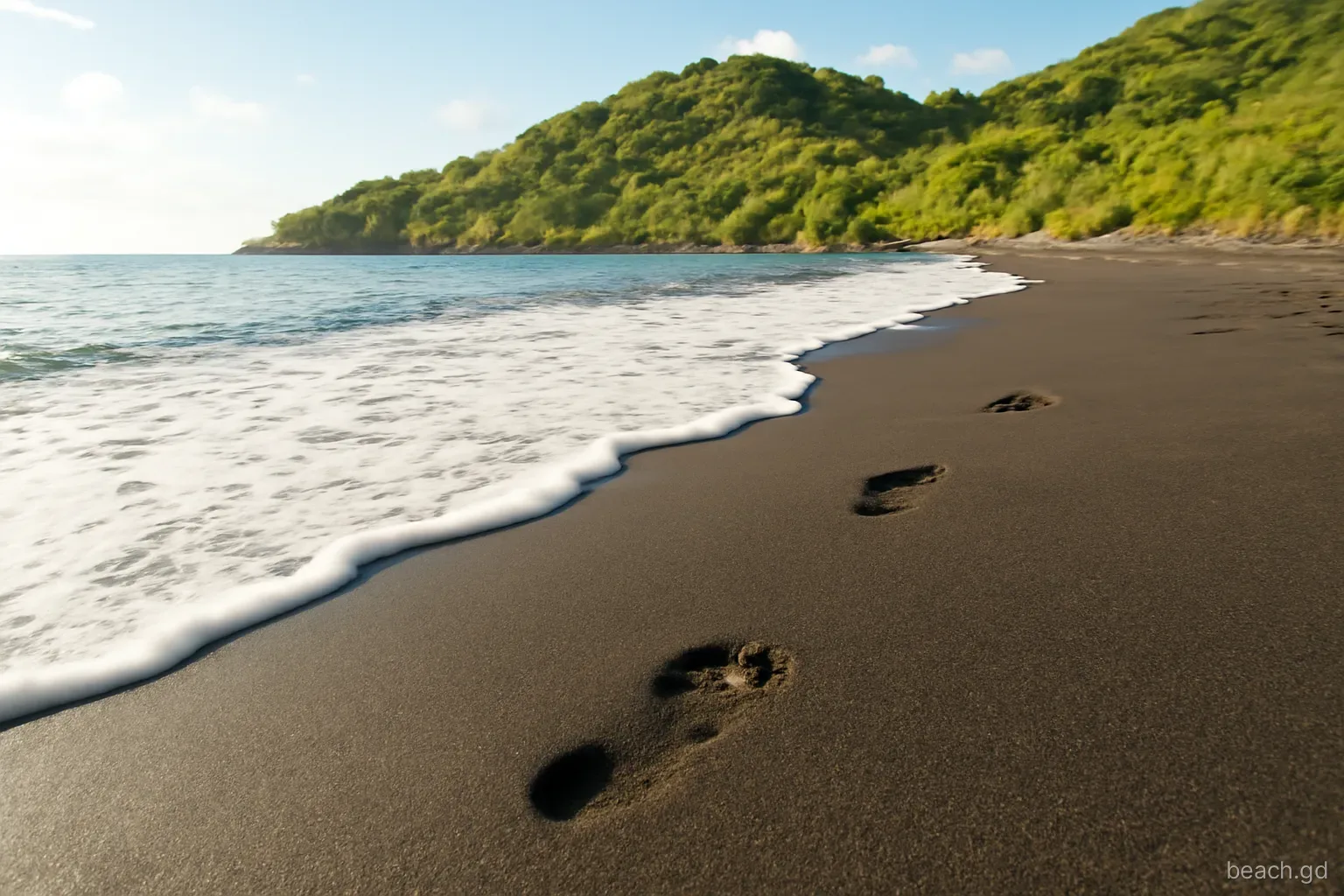
Most photographs of Grenada show pale gold sand at Grand Anse or the white sand of Carriacou's islets. Head north up the leeward coast past St George's and the colour starts to change. In St John and St Mark, many of the small bays below the coast road have dark grey to almost black sand, flecked with glints of mineral, and the water in front of them often looks deeper and bluer than at the southern beaches.
These coves see few visitors, partly because they are not on the usual tourist circuit and partly because people do not know what to expect. This piece explains why the sand is dark, where the volcanic beaches are, how they differ for swimming and comfort, and what to keep in mind when visiting.
Why some Grenada sand is black
Grenada is a volcanic island, built over millions of years by eruptions along the arc of the Lesser Antilles. Its active neighbour, the submarine volcano Kick 'em Jenny, lies off the north coast between Grenada and Carriacou. The rocks of the island's interior are largely volcanic: basalts, andesites and ash deposits that are dark in colour and rich in iron-bearing minerals.
Pale beaches form where sand is made mostly of broken coral, shells and the skeletons of reef organisms. That happens where reefs lie offshore, as along much of the south coast. Dark beaches form where rivers and streams carry eroded volcanic rock from the mountains to the sea, and where waves grind it down without much reef material to dilute it. The leeward coast of St John and St Mark, with steep valleys running straight down from the central mountains, is exactly that kind of shore.
Most Grenadian dark-sand beaches are a mixture rather than pure black, and the colour can shift with the season as storms move sand in and out.
Where to find the dark-sand coves
Black Bay, St John. A small bay below the coast road south of Gouyave, in the Concord area, whose name says it all. It is a local swimming spot rather than a visitor beach, with no facilities to speak of. Ask locally about the safest way down and where to park without blocking anyone.
The bays around Gouyave and Victoria. The fishing towns of the leeward coast sit on grey-to-dark beaches used mainly by fishermen and residents. They are working shores, with boats pulled up and nets drying.
Duquesne and the north-west. Near the island's north-west tip, Duquesne Bay has darker sand and a strong sense of history, with ancient petroglyphs recorded on rocks in the area.
Small unnamed coves. Between the larger bays, short stretches of dark sand appear below the road, often reached by informal paths through private land. Treat these with care; see the section on access below.
How dark-sand beaches feel different
A black-sand cove is a different experience from the pale beaches in the south. Know what to expect:
- The sand gets very hot. Dark sand absorbs more sunlight. By late morning in the dry season it can be painful to walk on barefoot. Bring sandals or reef shoes.
- The beach often shelves steeply. Many leeward coves drop quickly into deeper water, so children and weak swimmers are out of their depth within a few steps.
- The sand is coarser. Grains are often larger and heavier than coral sand, and stick less to wet skin.
- The water looks darker. Over a dark bottom the sea appears deep blue even in shallow water, which can make depth hard to judge.
- There is often little shade. Some coves have trees at the back; others are open to the full afternoon sun on this west-facing coast.
- Rivers matter. After heavy rain, streams entering these bays carry sediment and debris, clouding the water for a day or more.
Sand mining and why you should not take any
Grenada's dark-sand beaches have long been under pressure from sand mining. Sand is needed for construction, and taking it from beaches is cheaper than quarrying, so some bays have been stripped over the decades, leaving rocky shores where sand once lay and exposing the coast road to erosion. Removing sand from beaches is controlled by law in Grenada, and the authorities have periodically cracked down on illegal extraction.
For a visitor this has two practical meanings. First, do not take sand home, not even a small bottle as a souvenir; multiplied across many visitors, it adds up, and it is not permitted. Second, if a beach you remember from an old photograph now looks rocky or shrunken, mining or storms may be the cause. Beaches recover slowly, if at all, once their sand supply has been interrupted.
If you see trucks loading sand from a beach, do not intervene. You can report it to the police or to the relevant government ministry.
Access, parking and respect
The coast road along the leeward side is narrow and winding, with few safe places to stop. Many of the paths to dark-sand coves cross private land or run beside homes. The beach itself is generally open to the public, but the way down may not be. Ask before using a path that passes close to a house, close any gates you open, and do not leave cars where they block driveways, bends or bus stops.
These are mostly local beaches. People swim, wash nets, bathe children and hold family limes here. Visitors are generally welcome, but a quiet greeting, modest dress off the sand and keeping music low go a long way. Respect fishermen's space around boats and nets.
Take all rubbish away with you. There are rarely bins, and anything left on the beach ends up in the sea at the next high tide or storm.
Planning a leeward-coast cove day
The dark-sand coves are best visited as part of a slow drive up the west coast rather than as a single destination. A workable plan:
- Leave St George's early, ideally by 8am, before the sand heats up and before the coast road gets busy with trucks and buses.
- Drive north on the coast road, stopping only where there is safe room to pull off completely. Many bends are blind.
- Ask in a village shop or at a roadside stall which bay is good for swimming today and how to get down. People in St John and St Mark know which coves are calm and which paths are passable.
- Swim in the morning, when the water is calmest and the sand still comfortable.
- Have lunch in Gouyave or another coastal town, where small cookshops and snackettes serve local food.
- In the afternoon, when the sand is hottest, visit something inland or along the road rather than lying on a black beach in full sun.
- Head back before dark. The coast road is unlit in long stretches and much harder to drive at night.
Who these coves suit
Black-sand coves reward travellers who like a beach with local life rather than loungers, strong swimmers comfortable in deeper water, photographers interested in contrast and texture, and anyone exploring the leeward coast by car. They are a good antidote to a week on Grand Anse.
They suit less well families with toddlers, who need a gentle slope and shade, and anyone who needs toilets, food and lifeguards close at hand. For them, a short look from the road and a swim back at a southern beach such as Morne Rouge or Grand Anse may be the better plan, keeping the black-sand coves for a scenic stop on the drive north. If you do bring children, choose a calm morning, pick a cove where the slope is gentle near the shore, and stay within arm's reach.
Frequently asked questions
Does Grenada have black-sand beaches?
Yes. Grenada is volcanic, and several bays on the leeward coast, especially in St John and St Mark, have dark grey to black sand formed from eroded volcanic rock. They are small local beaches rather than resort beaches, with few or no facilities.
Where is Black Bay in Grenada?
Black Bay is on the leeward coast in the parish of St John, south of Gouyave near the Concord area. It is a small local beach below the coast road. Ask locally about the best way down and where to park without blocking homes or the road.
Are black-sand beaches safe for swimming?
They can be, on calm days. Many leeward coves shelve steeply, so the water gets deep quickly, and the dark bottom makes depth hard to judge. Weak swimmers and children need close supervision. Avoid swimming near river mouths after heavy rain.
Why does black sand get so hot?
Dark sand absorbs more of the sun's energy than pale coral sand and holds the heat. By late morning, especially in the dry season, it can be too hot to walk on barefoot. Bring sandals or reef shoes and lay a towel down before sitting.
Can you take black sand home as a souvenir?
No. Removing sand from beaches is controlled by law in Grenada, and sand mining has already damaged some bays. Leave the sand where it is; photographs make a better souvenir and do not contribute to coastal erosion.