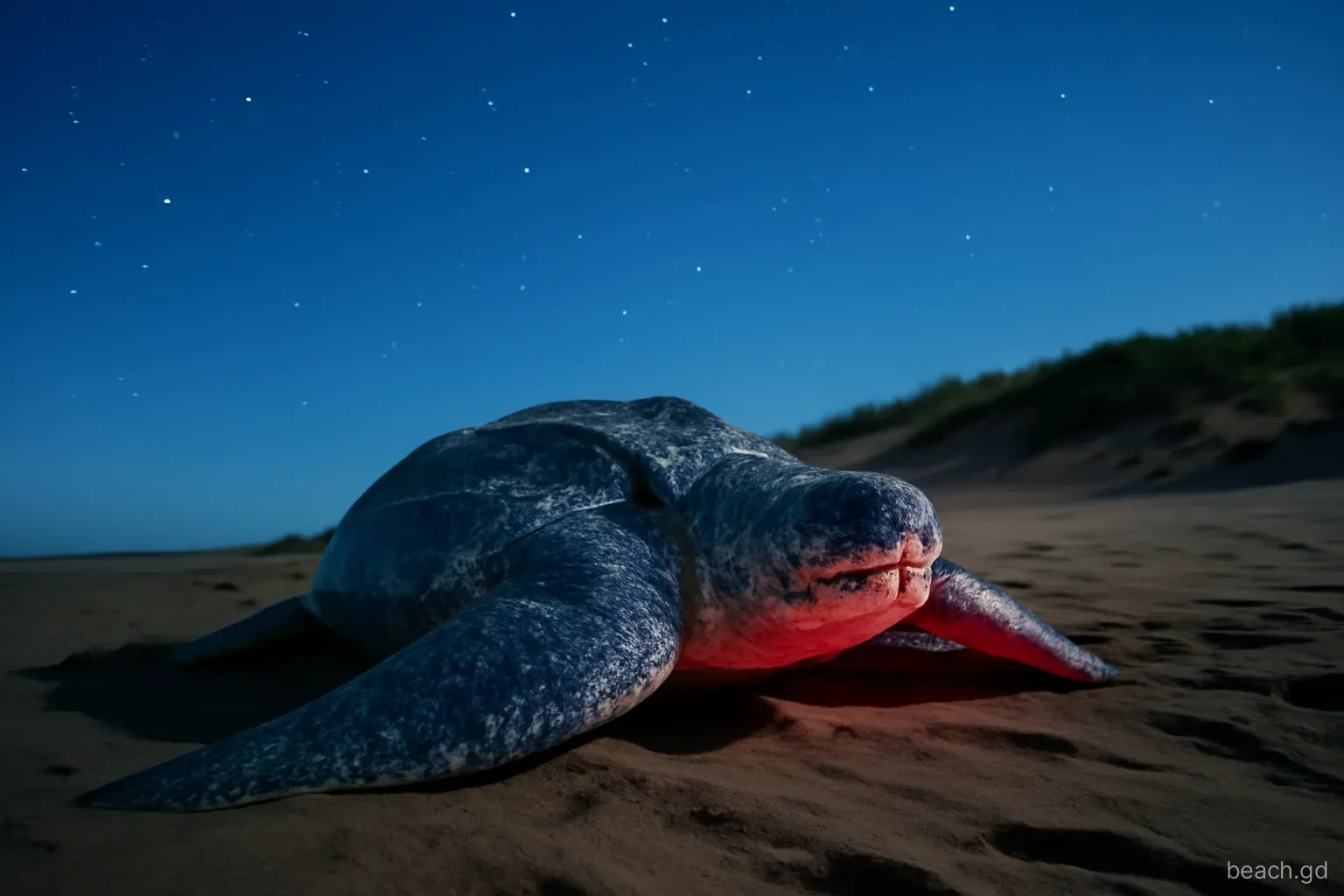
Each year, from around March, some of the largest reptiles alive haul themselves out of the Atlantic onto the beaches of north-east Grenada to lay their eggs. Leatherback turtles can weigh several hundred kilograms and measure close to two metres along the shell, and watching one dig a nest at night is one of the most remarkable wildlife experiences in the Caribbean.
This guide explains the timing of the season, which beaches matter most, what happens on a nesting night and what the hatching months look like. For the rules on visiting a nesting beach and how organised turtle watching works, see our separate guide to turtle watching at Levera.
The season at a glance
Leatherback nesting in Grenada runs broadly from March to August, with the busiest period usually from about April to June. The first and last weeks of the season see only scattered nesting, so a visit in the core months gives the best chance of an encounter, although no night is guaranteed.
Hatching follows roughly two months after laying. Eggs laid in April typically hatch in June, and nests laid late in the season can still be producing hatchlings into August and September. That means the second half of the season offers the chance of seeing both nesting females and emerging hatchlings, while the early season is about adults only.
Outside these months, from around October to February, there is effectively no leatherback nesting. A January visit will not include turtle watching, however good the rest of the beach weather is. Grenada's fisheries rules reflect the season: the Levera Beach closed area applies from 1 April to 31 August, and leatherbacks are protected year-round.
Where leatherbacks nest
Levera Beach, St Patrick. The most important and best-known nesting beach in Grenada, inside Levera National Park at the northern tip of the island. It faces offshore islands including Sugar Loaf and has a wide, steep sand beach that suits large turtles. It is monitored by conservation groups during the season.
Bathway Beach and the north-east coast. Just south of Levera, Bathway and neighbouring stretches of the Atlantic coast also receive nests. Bathway is a popular day beach, so nesting there happens alongside regular human use.
Other east coast beaches. Leatherbacks nest at lower densities on a number of other Atlantic beaches. Many of these are remote and not monitored as closely.
Occasional nests elsewhere. Nests sometimes turn up on beaches on the south and west coasts. In May 2026 a leatherback was illegally killed at a beach in Lance aux Epines on the south coast, a reminder that turtles come ashore well beyond the famous sites.
Carriacou. Leatherbacks and hawksbills nest on some Carriacou beaches, where the KIDO Foundation has long been involved in turtle monitoring.
What happens on a nesting night
Nesting follows a predictable sequence, which is why trained guides can tell visitors exactly when it is safe to approach. A full nesting usually takes one to two hours.
- The female emerges from the surf, usually at night and often around high tide, and pauses to assess the beach. Lights, noise and movement at this stage can make her turn back to sea.
- She crawls up above the high-water line, leaving a wide track that looks like a tractor has driven up the sand.
- She sweeps away surface sand with her front flippers to make a body pit.
- Using her rear flippers like scoops, she digs an egg chamber deeper than the length of a person's arm.
- She lays her eggs, typically in the region of 80 yolked eggs plus a number of smaller yolkless ones. During laying she is less easily disturbed, and this is when guides allow visitors closer.
- She fills in the chamber, then throws sand in all directions to disguise the site, which can take a surprising amount of time.
- She returns to the sea, often resting on the way down the beach.
Leatherback biology in brief
Leatherbacks are unlike other sea turtles. Instead of a hard shell, they have a flexible carapace of leathery skin over a mosaic of small bones, with ridges running from front to back. They dive to great depths and migrate across ocean basins, feeding mainly on jellyfish. The turtles that nest in Grenada spend most of their lives far out in the Atlantic.
A female does not nest every year; she typically returns every two to three years. In a nesting year she comes ashore several times, roughly every nine to ten days, laying a new clutch each time. This is why the same turtle may be seen more than once in a season and why monitoring groups tag and record individuals.
The temperature of the sand during incubation influences whether hatchlings become male or female, with warmer nests producing more females. Only a small proportion of hatchlings survive to adulthood, which is why the protection of every nesting female matters so much.
Hatching: the second half of the story
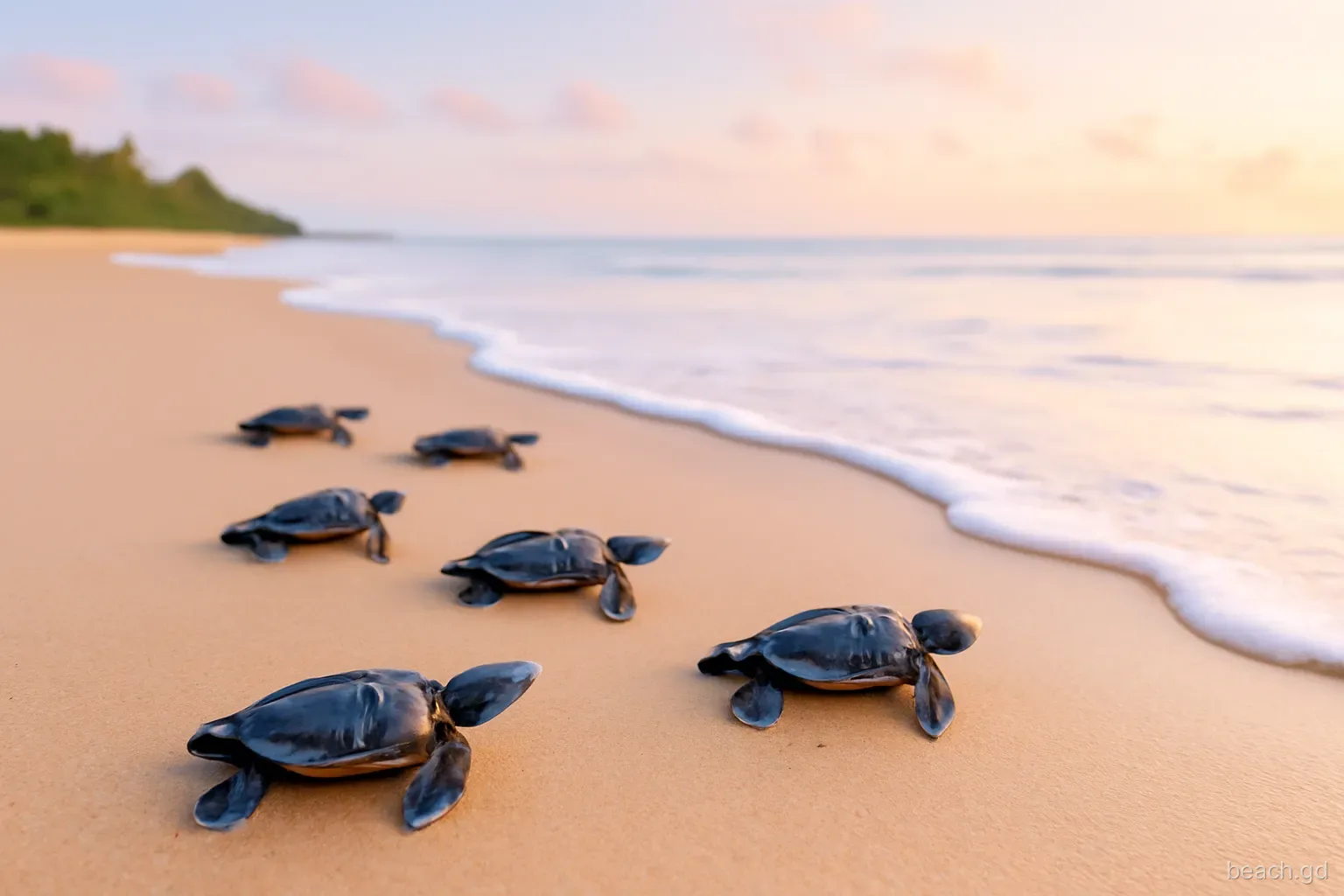
About two months after laying, the hatchlings break out of their eggs underground and work together to dig up through the sand, a process that can take several days. They usually emerge at night or in the cool of early morning, when the sand is cooler and predators are fewer, bursting out of the nest in a group and scrambling towards the sea.
Hatchlings find the water by heading towards the brightest horizon, which on a natural beach is the open sea reflecting moonlight and starlight. Lights from buildings, roads or torches can draw them inland, where they die from exhaustion, dehydration or predators. This is why lighting near nesting beaches matters so much.
Hatchling leatherbacks are only a few centimetres long. Their first swim takes them away from the coast into open water, and very few of them survive the years it takes to reach adulthood. Seeing an emergence is a rare privilege; if it happens near you, keep lights off, stay back and let them make the journey unaided.
Who watches the beaches
Turtle monitoring in Grenada has relied for many years on a partnership of conservation groups, community members and government. Ocean Spirits has worked on leatherback research and monitoring in Grenada for many years, with patrols, tagging and data collection on the north-east beaches, and trained local guides have become central to turtle watching at Levera.
In Carriacou, the KIDO Foundation has long been involved in turtle monitoring and conservation work. The Fisheries Division sets and enforces the rules, and police support patrols during the nesting season, particularly after incidents of poaching.
Monitoring teams count nests, record tagged females, relocate nests at risk from erosion when necessary and collect data that feeds into regional networks such as WIDECAST. Some groups take volunteers during the season; check current programmes directly with the organisations before travelling.
Month by month: what to expect
Turtle activity changes through the year. This rough calendar helps plan a visit, but individual seasons vary with ocean conditions, and a strong year at Levera can be followed by a quiet one because females do not nest every year.
- February: no regular nesting; occasional very early arrivals are possible but rare.
- March: the season begins; nesting is sporadic.
- April: nesting increases and the Levera closed area takes effect from 1 April.
- May and June: usually the peak months for nesting females; the first hatchlings appear from about late May or June.
- July: nesting continues at a lower rate while hatching becomes more frequent.
- August: late nests and many hatchlings; the closed area ends on 31 August.
- September: the last hatchlings emerge from late nests.
- October to January: no leatherback nesting; hawksbills may still nest on some beaches.
Common misunderstandings
A few assumptions regularly lead visitors to disappointment, or worse, to disturbing turtles. Most come from treating turtles like a scheduled attraction rather than wild animals following their own rhythms.
- Assuming turtles are visible at any time of year; leatherbacks nest only in the season described above.
- Thinking any beach walk at night is harmless; torches, phones and flash photography can turn a turtle back to sea.
- Believing hatchlings need help to reach the water; handling them does harm, and they should crawl unaided.
- Expecting a guaranteed sighting on an organised tour; turtles come ashore on their own schedule.
- Visiting Levera at night in season without an authorised guide; this is prohibited under the closed area rules.
- Assuming all turtle species follow the same calendar; hawksbills nest over a longer period, often later in the year.
Frequently asked questions
What is the best month to see leatherback turtles in Grenada?
May and June are usually the best months for nesting females, with April also good. If you would like a chance of seeing hatchlings as well, late June to August is better. Nesting is never guaranteed on any single night, so allowing two or three nights improves your chances.
How big are leatherback turtles?
Adult leatherbacks are the largest living turtles. Nesting females commonly weigh several hundred kilograms and their shells can approach two metres in length, although size varies widely. Seeing one up close on a beach, even in dim red light, is striking because of their sheer bulk.
Where is Levera Beach?
Levera Beach is at the northern tip of Grenada in the parish of St Patrick, within Levera National Park, a short drive from Sauteurs and close to Bathway Beach. It faces offshore islands including Sugar Loaf. During nesting season, night access is restricted to authorised turtle watching.
Do turtles nest on Grand Anse Beach?
Grand Anse is not a major nesting beach, partly because of lighting and heavy use, but turtles do come ashore on south and west coast beaches occasionally. If you see a turtle or a track on any beach, keep your distance, keep lights off and report it.
How long does a leatherback take to nest?
A full nesting, from leaving the sea to returning, usually takes one to two hours. Digging the body pit and egg chamber takes much of that time, the laying itself is relatively short, and covering and disguising the nest can take longer than visitors expect.