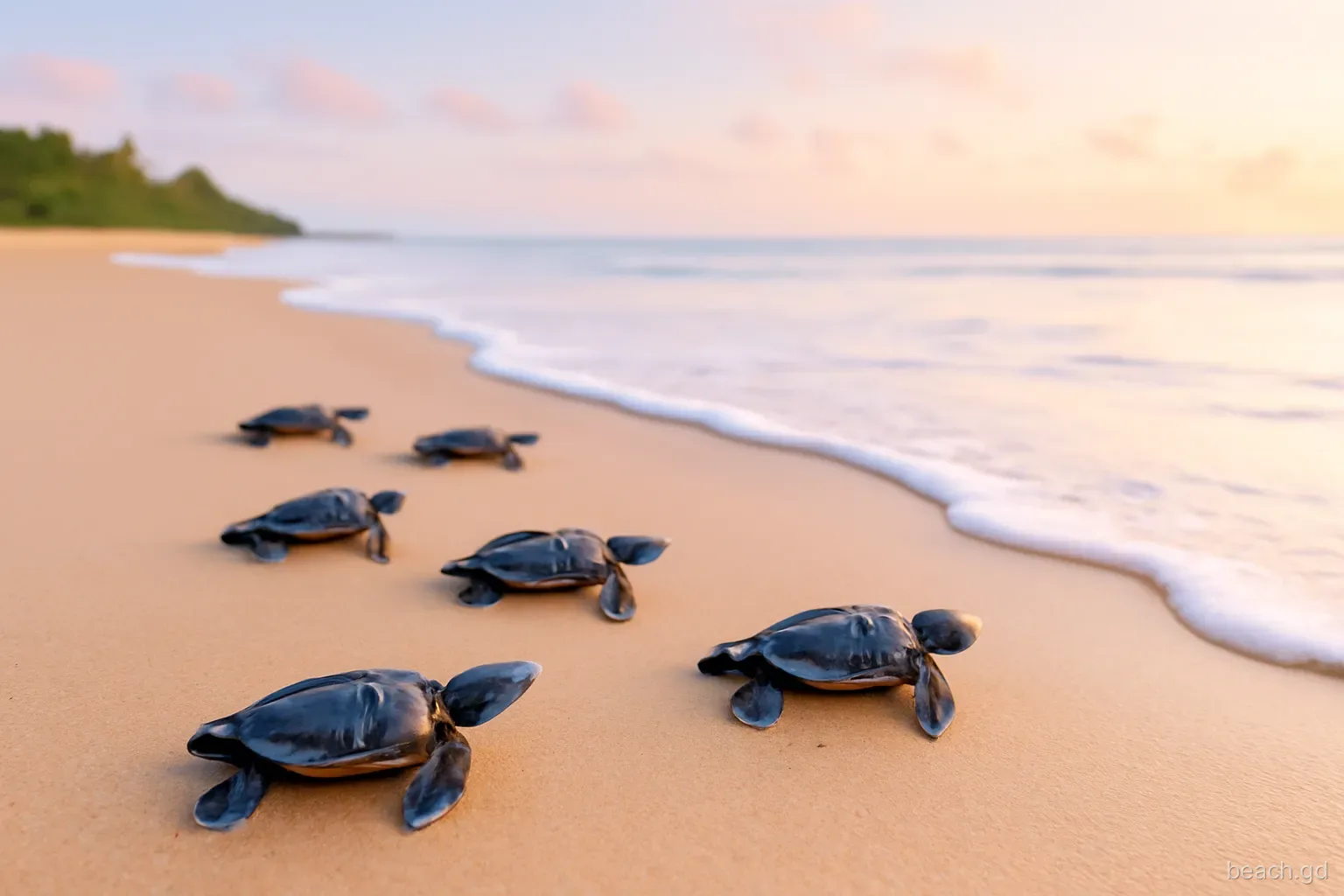
Sooner or later, many people who spend time on Grenada's beaches come across something unexpected: a wide track up the sand at dawn, a cluster of tiny turtles heading the wrong way under a streetlight, a turtle tangled in fishing line, or a person digging where a nest should be. What you do in the next few minutes can matter.
This guide sets out practical steps for each situation, the mistakes to avoid and how to report problems. It also summarises the law that protects turtles and eggs in Grenada, so you know when something you see is not just unwise but illegal.
If you see a turtle nesting
Turtles can come ashore on beaches across Grenada and Carriacou, not only at Levera and Bathway. If you meet one unexpectedly, the priority is to let her finish undisturbed.
- Stop where you are and turn off all lights, including phone screens. Do not use flash.
- Move back and stay well behind the turtle, out of her line of sight, and keep quiet.
- Keep other people, children and dogs away; calmly explain why if needed.
- Do not touch her or try to get close for photographs, especially before she starts laying.
- Watch from a distance until she returns to the sea, which may take an hour or two.
- Note the location, time and, if possible, which species it appeared to be, and report it to a turtle monitoring group or the Fisheries Division so the nest can be recorded.
- Do not mark, dig into or disturb the nest site afterwards.
If you find hatchlings
Hatchlings normally emerge at night or around dawn and head straight for the sea, guided by the brighter horizon over the water. If they are crawling towards the sea, the best thing to do is nothing: keep lights off, stand still and well back, keep dogs and people away, and let them reach the water by themselves.
If they are heading inland, towards lights on a road, a hotel or a house, the light is the problem. Turn off or shield the light if you can, or ask the property owner to do so, and stand between the light and the hatchlings to shade them. Contact a turtle monitoring group or the Fisheries Division for advice as soon as possible.
Avoid picking hatchlings up, carrying them to the sea or putting them in water containers unless trained people advise it. Handling can harm them, and the crawl across the beach is thought to help them orient. Never keep hatchlings to release later or to show children; they need to reach the sea quickly.
If you find a stranded, injured or entangled turtle
Keep your distance at first. Adult turtles are strong, and their flippers and beaks can injure you. Assess from a safe distance.
Call for help. Contact the Fisheries Division, a turtle monitoring group, or the police. Give the exact location, the size and condition of the turtle and any visible injuries or entanglement.
Keep it shaded and moist. If the turtle is out of the water and cannot move, shade it and keep its shell and skin damp with a wet towel, avoiding the nostrils and eyes.
Do not push it back into the sea. An injured or exhausted turtle may drown. Wait for advice.
Do not lift it by the flippers or shell edge. This can cause injury. Let trained people handle it.
Entanglement. If a small amount of line is wrapped around a calm turtle in shallow water and you are confident, carefully cutting loose ends may help, but never pull line that is embedded or swallowed. Report it.
If you see poaching or nest digging
Killing leatherbacks, taking turtle eggs and disturbing nests are illegal in Grenada at all times. Other turtle species are protected during the closed season from 1 April to 31 August, and undersized turtles may not be taken at any time. In May 2026 a leatherback was illegally killed at a beach in Lance aux Epines, and the authorities responded by working with police to increase beach patrols during the nesting season.
If you see someone killing a turtle, taking eggs or digging up a nest, do not confront them; situations can escalate. Move to a safe distance and note the time, place, number of people, descriptions and any vehicles or boats involved. If a crime is in progress, call 911 and ask for the police. Report it to the Fisheries Division as well.
Photographs or video taken from a safe distance can help, but your safety comes first. Afterwards, tell the turtle monitoring groups so they can check the site and record the incident.
Selling turtle meat during the closed season, or offering leatherback meat or turtle eggs at any time, is also illegal. If you see these on sale at a market, a roadside stall or a restaurant, note the details and report them to the Fisheries Division rather than buying or arguing with the seller.
The law in brief
Grenada's fisheries regulations protect turtles in several ways. Leatherbacks may not be fished for, taken, sold, bought or possessed at any time, and their nests may not be disturbed. Turtle eggs of all species are fully protected: nobody may disturb, take, sell, buy or possess them. Turtles below the harvestable size may not be taken, and there is a closed season for turtles from 1 April to 31 August, during which turtle fishing and nest interference are prohibited.
Levera Beach is a separate closed area from 1 April to 31 August under the Levera Beach Closed Area Regulations, with official notices warning of fines of up to EC$5,000, up to two years' imprisonment, or both for violations.
Outside the closed season, regulated harvesting of hard-shelled turtles above minimum sizes has been legal, which conservation groups have long opposed. International rules also apply: turtle products, including tortoiseshell jewellery, are covered by wildlife trade bans and can be seized at your home border. Laws change, so check current regulations with the Fisheries Division.
Beachfront properties: lighting and habits
If you rent or own a property near a nesting beach, a few changes during the season make a measurable difference to nesting females and hatchlings. Hotels near nesting beaches in many countries have adopted these habits, and they cost very little.
- Turn off unnecessary outdoor lights facing the beach at night, especially from March to September.
- Use shielded, downward-facing fixtures and warm, low-intensity lights, such as amber or red bulbs, where lighting is needed.
- Close curtains or blinds on beach-facing rooms at night.
- Remove beach furniture, kayaks and boats from the sand at night, as they block nesting turtles and trap hatchlings.
- Fill in holes dug in the sand during the day and knock down sandcastles before leaving.
- Keep dogs on a lead or indoors at night on nesting beaches; dogs dig up nests.
Why individual reports matter
Turtle monitoring in Grenada relies on patrols, but nobody can watch every beach every night. Reports from residents, fishers, hotel staff and visitors fill the gaps, especially on less visited beaches on the east and south coasts and in Carriacou. A single report of a track or nest helps monitoring groups understand where turtles are nesting and protect those nests.
Reports of dead or injured turtles help identify threats such as boat strikes, entanglement or poaching hotspots. Reports of lights disorienting hatchlings can lead to conversations with property owners and better lighting along the coast.
When reporting, be as specific as possible: the beach name, the nearest landmark, the time and what you saw. A photograph taken without flash and from a respectful distance is often more useful than a long description.
Frequently asked questions
Who should you call if you find an injured turtle in Grenada?
Contact the Fisheries Division, a turtle monitoring group, or the police, giving the exact location and the turtle's condition. In an emergency, especially where an animal is being harmed or a crime is in progress, call 911. Keep the turtle shaded and damp until help arrives.
Should you help hatchlings reach the sea?
Usually not by touching them. If they are heading towards the water, simply keep lights off and stand back. If they are disoriented by artificial light, turn off or shield the light and shade them, then contact a monitoring group for advice. Handling can do harm.
Is it illegal to eat turtle eggs in Grenada?
Yes. Turtle eggs of all species are protected at all times, and it is illegal to disturb, take, sell, buy or possess them. Leatherbacks are also fully protected year-round. Report anyone selling or collecting eggs to the Fisheries Division or the police.
Is turtle meat legal in Grenada?
Leatherback meat is illegal at all times. For other species, regulated harvesting of turtles above minimum sizes has been permitted outside the closed season from 1 April to 31 August. Conservation groups oppose this and many visitors choose not to eat turtle. Laws can change, so check current rules.
What does a turtle track look like on the beach?
A turtle track looks like a wide, regular trail from the water up the beach, made by the flippers, with a disturbed area of sand at the top where the turtle dug. Leatherback tracks are very wide, often well over a metre. If you see a fresh track, avoid walking on the nest area and report it.