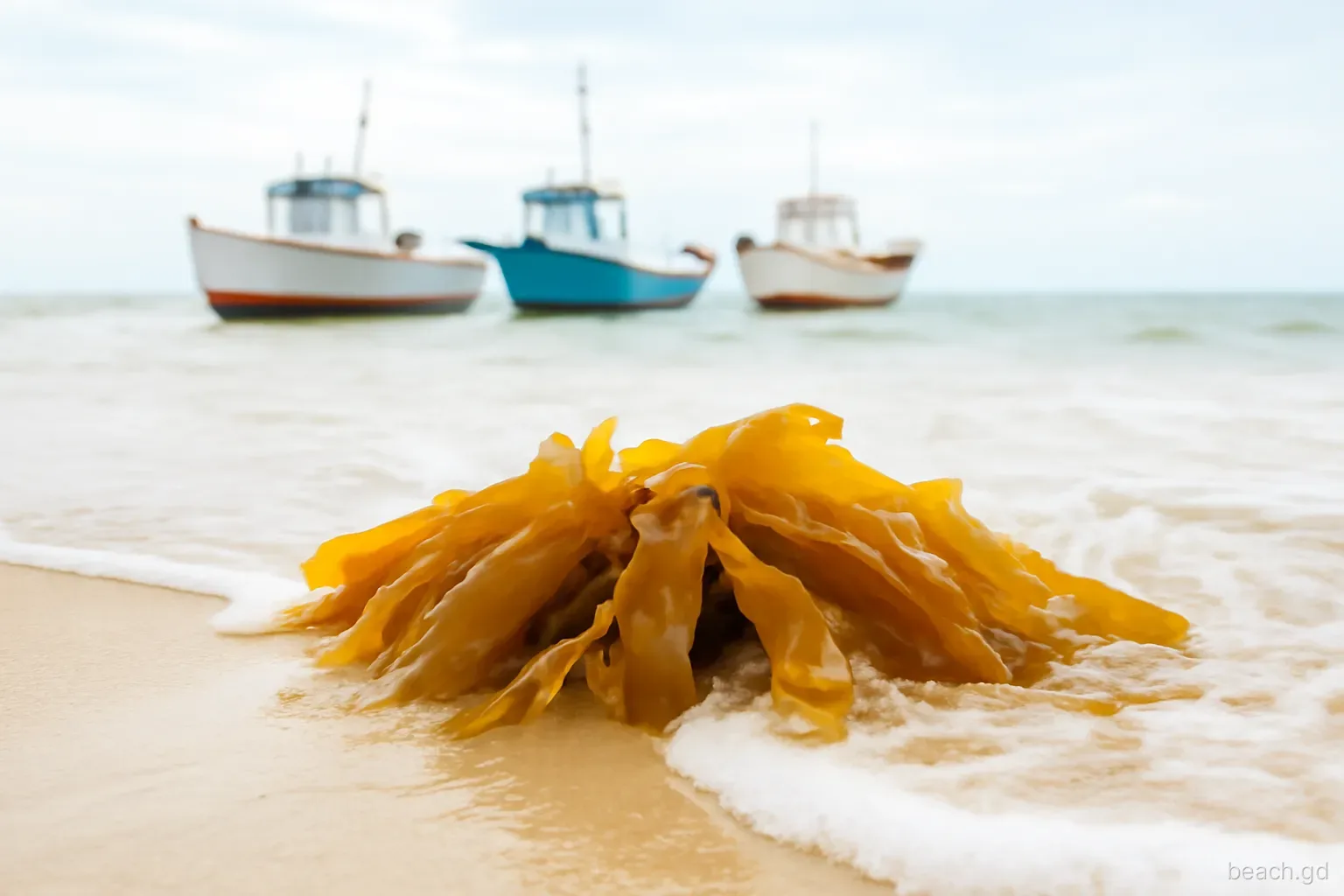
If you drive over to the east coast and find a beach knee-deep in brown, rubbery weed with a smell like old eggs, you have met sargassum. Since around 2011, huge rafts of this floating seaweed have drifted into the eastern Caribbean in many years, and on Grenada they land overwhelmingly on the windward side: the bays of St Andrew, St Patrick and St David that face the Atlantic trade winds.
Sargassum is unpredictable. Some years bring weeks of heavy landings; others barely register. The same beach can be clean one morning and smothered by afternoon. This page explains where it tends to collect, when, what it means for swimming and health, and how to rearrange a beach day so it does not ruin a trip.
What sargassum is and why it comes ashore here
Sargassum is a free-floating brown seaweed, held up by small gas-filled bladders that look like peppercorns. Out at sea it forms mats that shelter fish, crabs and young turtles, and in moderation it is part of a healthy ocean. The problem is scale. Since the early 2010s, scientists have tracked a vast belt of sargassum across the tropical Atlantic, far from the Sargasso Sea that gave it its name, and in bloom years currents and wind push enormous quantities west into the Caribbean.
Grenada sits in the path of the north-east trade winds. Anything floating on the Atlantic side is driven towards east-facing shores, and the shape of the bays decides where it piles up. Shallow, reef-fronted bays with a narrow entrance trap weed and hold it, because waves carry it in but cannot easily carry it out. Open beaches with strong wave action churn it up and sometimes clear themselves within days.
Which beaches tend to get it
Grenville Bay and the St Andrew shore. The long reef-fronted bay at Grenville, and the coves and fishing beaches south towards Telescope and Marquis, face the trades squarely and are among the first places to show heavy landings. Fishers here feel it most, because weed fouls engines and nets.
The St David windward coves. The south-eastern bays that open to the Atlantic can collect weed in sheltered corners even when nearby headlands stay clear.
Bathway and Levera. Both face the Atlantic on the north-east corner. Bathway's rock shelf catches some weed before it reaches the pool, but strands still drift in, and Levera's long open beach can carry a thick band along the tide line in bad spells.
The leeward coast, rarely. Grand Anse, Morne Rouge, Grand Mal, Gouyave and the other west-facing beaches are sheltered from the Atlantic and usually stay clear even when the east coast is badly hit. Odd strands can wrap around the southern headlands, but heavy accumulations on the Caribbean side are uncommon.
Carriacou's windward side. The same pattern repeats on the sister island, where east-facing shores collect weed while the western bays stay cleaner.
Season and day-to-day variation
Across the region, the heaviest influxes usually fall somewhere between spring and early autumn, often building from around April and easing by September or October. That broad window overlaps with Grenada's rainy season and with turtle nesting on the east coast. Within it, though, there is no reliable calendar. A big raft offshore can land in a single tide; a change in wind can hold it off for a week.
Because of this, forecasts based on satellite observations of the Atlantic are useful for the season as a whole but not for choosing a particular morning. Locally, the best information comes from people who live on the coast: your accommodation, a taxi driver from St Andrew, or a quick look at recent photographs posted by residents. Winter months, when the stronger Christmas winds blow, have historically been quieter for sargassum, although the sea itself is rougher then.
Time of day matters a little too. Weed that lands overnight is fresh and smells only of the sea; the odour builds as piles sit in the sun over following days. A beach that was hit a week ago and not cleared can be worse to visit than one receiving a fresh load that morning. If you arrive and the smell is strong near the back of the beach, the waterline upwind is often perfectly pleasant.
Health and comfort: what to know
Fresh, floating sargassum is harmless to touch. The issues start when it piles up and rots on the sand.
- The smell. Decomposing weed releases hydrogen sulphide, which gives the rotten-egg smell. In open air on a breezy beach it is mostly unpleasant rather than dangerous, but concentrated in sheltered spots it can irritate eyes, nose and throat.
- People with asthma or breathing problems should avoid lingering near large rotting piles and should not sleep in rooms right beside them with windows open.
- Swimming through it. Thick mats in the water are unpleasant and can hide small stinging creatures and debris. They also make it harder to judge depth and currents. Choose clear water.
- Children and dogs tend to dig into the piles. Wash hands and paws afterwards and keep both away from the rotting layer underneath.
- Metal and electronics. Coastal residents report that hydrogen sulphide tarnishes silver and corrodes some metals over time; it is a reason to keep gear away from piles rather than a risk on a single visit.
What it means for the people who live on this coast
For visitors sargassum is an inconvenience; for east coast communities it can be a serious economic problem. Fishers working from Grenville, Soubise and the St Patrick villages describe weed clogging engine intakes, tangling nets and lines and making it hard to launch from beaches covered in a thick, heavy layer. Some days boats simply stay ashore. Guesthouses and bars on the windward side lose custom when the smell drifts inland, and residents close to the shore deal with the odour in their homes for weeks at a time.
Clearing it is harder than it looks. Wet sargassum is heavy, and scraping it with machinery removes sand along with weed, which can worsen erosion and disturb turtle nesting beaches. Manual clearing is slow and the next tide can bring more. Across the Caribbean, governments, researchers and small businesses have experimented with barriers to deflect it, collecting it at sea and turning it into compost, fertiliser or building materials, with mixed results so far.
If you are on the east coast during a bad spell, the kindest response is patience. Spend money locally even when the beach is not at its best, and follow any guidance from residents about where weed is being piled or burned.
Planning a beach day when the weed is in
Sargassum is a reason to change plans, not a reason to skip the east coast entirely. A simple routine keeps the day intact.
- Ask before you drive. A quick question to someone on the east coast the evening before saves a long trip to a weed-covered beach.
- Have a leeward fallback. If the windward beaches are bad, Grand Anse, Morne Rouge, Grand Mal or the coves south of St George's are usually clean.
- Visit for the scenery rather than the swim. Lake Antoine, River Antoine, the Grenville market and the drive itself are worth the trip even when the beaches are not.
- If you do go, choose open beaches with wave action over enclosed bays, and check the pool at Bathway with the lifeguards.
- Respect clean-up work. Communities and agencies clear weed from key beaches when they can; stay out of the way of machinery and do not drive onto the sand to get closer.
Frequently asked questions
When is sargassum season in Grenada?
There is no fixed season, but across the eastern Caribbean the heaviest landings usually fall between spring and early autumn, often from around April to September. Some years see little weed; others bring repeated waves of it. The winter months have tended to be quieter.
Is it safe to swim when there is sargassum?
Swimming in clear water near a few floating strands is fine. Avoid swimming through thick mats, which can hide debris and small stinging animals, and keep away from large rotting piles on the shore, where hydrogen sulphide builds up. Choose another beach if the water is covered.
Does sargassum reach Grand Anse Beach?
Rarely in any quantity. Grand Anse faces west onto the Caribbean Sea and is sheltered from the Atlantic currents that carry the weed. On days when the east coast is badly affected, the south-west beaches are usually the easiest alternative.
Why does sargassum smell so bad?
As the weed rots on the sand, bacteria break it down and release hydrogen sulphide gas, which has the typical rotten-egg smell. The smell is strongest in sheltered spots with little breeze and in piles that have been sitting for several days in the heat.
Is sargassum dangerous to touch?
Fresh, floating sargassum is not harmful to touch for most people. Rotting piles are less pleasant: they can contain small creatures and the decaying layer underneath irritates skin for some. Wash your hands afterwards and avoid letting children dig into old piles.
Which Grenada beaches are worst for sargassum?
East-facing bays with reefs or narrow openings that trap weed, such as Grenville Bay and nearby St Andrew beaches, tend to be worst, along with some windward coves in St David and St Patrick. Leeward beaches on the west and south-west coasts are usually far less affected.