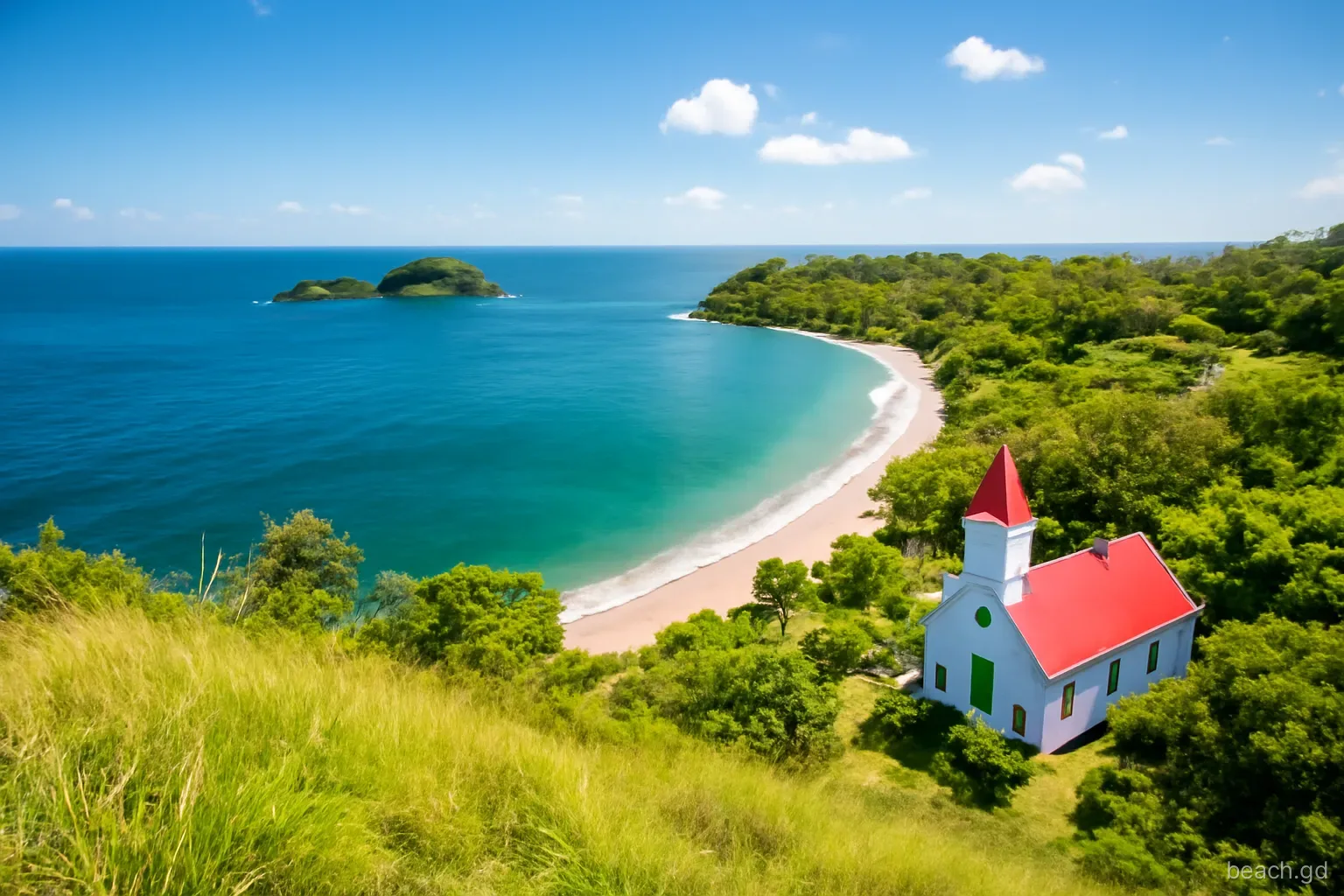
At Sauteurs, the main island of Grenada runs out of land. The town sits above a curving bay at the far north, and from the cliffs beside it the view runs straight across open water to the first of the Grenadines: Caille, Ronde, Diamond and, on clear days, Carriacou beyond. It is one of the great viewpoints of the island and a place with a heavy history.
The beaches up here are different again from the leeward bays to the south and the Atlantic beaches to the east. They catch swell from the north, they are used first by fishermen, and they reward visitors who come for the scenery and the story as much as the swim. This page covers Sauteurs Bay and its neighbours, what the water is like and how to visit well.
Sauteurs Bay: the town beach
Sauteurs is the capital of St Patrick and the largest town in the north, a fishing and market town of narrow streets set on a slope above the bay. The beach below runs in a gentle curve, with sand from golden-grey to darker grey, fishing boats drawn up along it and the fish market close by. On weekday mornings the boats come in, catches are landed and sold, and the waterfront is at its busiest.
For visitors, Sauteurs Bay is a place to walk, watch and perhaps swim on a calm day rather than a beach to spend hours on. There are no tourist facilities on the sand. Shops, bakeries and small restaurants in town supply food and drink, and the town is a natural stop for lunch on a drive around the north. The main attraction is the setting: the islands on the horizon, the cliffs at the western end of the bay and the church above them.
Leapers' Hill: why the town has its name
Sauteurs means "jumpers" in French. In the early 1650s, during the French campaign to take Grenada from its Indigenous Kalinago (Carib) inhabitants, a group of Kalinago were driven to the cliffs at the northern edge of the island. Rather than be captured, according to the long-standing account, they leapt to their deaths on the rocks and sea below. The cliff is known as Leapers' Hill or Caribs' Leap, and it is one of the most significant historical sites in Grenada.
Today there is a small heritage site at the top, close to St Patrick's Roman Catholic church, with a cemetery running towards the cliff edge and wide views over the bay. Interpretation and facilities at the site have changed over the years; check locally whether the visitor centre is open. Visit with the respect you would give any memorial. Stay back from the edge, which is unfenced in places, and keep children close. The view from here explains the geography of the whole region better than any map.
The other north coast beaches
Petite Anse. East of Sauteurs, a small cove with a sandy beach facing north towards the Grenadines, quieter than the town bay. It has the same exposure to northerly swell, so conditions vary widely with the season. On calm days it is one of the prettiest swims in the north.
Irvin's Bay. A bay on the north coast with a deep place in Grenadian history: it was a harbour for shipping estate produce in the colonial era, and the ship Maidstone landed the first indentured Indian labourers to Grenada here in the mid-nineteenth century, an arrival remembered on Indian Arrival Day. Today it is quiet, with a shoreline used mainly by local people.
Towards Levera. Further east, the north coast bends round towards Bathway and Levera, where the Atlantic takes over and conditions get rougher again.
Small fishing coves. Between these, small pockets of sand serve as landing places for village boats. Respect them as working spaces and private access points.
Swimming on the north coast: what to know
The north coast faces neither the full Atlantic trade winds nor the sheltered Caribbean. Its main hazard is swell from the north.
- Winter ground swells, roughly from December to March, roll down from storms in the North Atlantic and hit north-facing beaches directly. Waves can break heavily on the sand and backwash is strong.
- Calm periods, often from April to early summer and between swells in autumn, bring flat water and pleasant swimming in bays like Petite Anse and parts of Sauteurs Bay.
- No lifeguards work these beaches. Swim only when it is clearly calm, ideally where local people are swimming.
- Boats come and go at Sauteurs. Keep away from launch areas and moorings.
- Currents near headlands can be strong. Stay in the middle of a bay rather than near the points.
- The channel to the north is open sea with strong currents; it is not a place for long swims offshore.
The islands on the horizon
The view north from Sauteurs takes in the southern Grenadines that belong to Grenada. Closest are a cluster of small, mostly uninhabited islands, including Caille, Diamond and Ronde, with Carriacou further off. Between the main island and Ronde lies Kick 'em Jenny, an active submarine volcano. It cannot be seen, but the authorities maintain a maritime exclusion zone around it whose size depends on the current alert level, and boats travelling north to Carriacou route accordingly.
For beachgoers, the islands are mainly scenery, but they also explain the light and colours here. Late afternoon sun from the west lights the islands and the sea in long golden tones, and in the dry season, when the air is clear, the view can stretch a remarkably long way. Saharan dust in summer often reduces the horizon to haze.
Sauteurs through the year and through the day
In winter, the north coast shows its wild side. Northerly ground swells, at their most frequent from around December to March, roll in from distant Atlantic storms and break heavily along Sauteurs Bay and the coves to the east. The sight from Leapers' Hill on a big swell day is spectacular, with white water along the whole shore, but it is no time for swimming. The air is often clearest in these months, and the islands to the north stand out sharply.
From around April, swells become less frequent and the sea often settles into long calm spells. This is the best time for a swim at Petite Anse or in the town bay, and for a slow lunch overlooking the water. The rainy season from June brings afternoon showers, hazier horizons when Saharan dust drifts across and, occasionally, swells from passing tropical systems.
Across the day, mornings are best for the fish market and the clearest light on the islands; afternoons are best for the view west along the coast, which takes on a warm glow as the sun drops. Plan the order of your stops with that in mind.
Planning a north coast visit
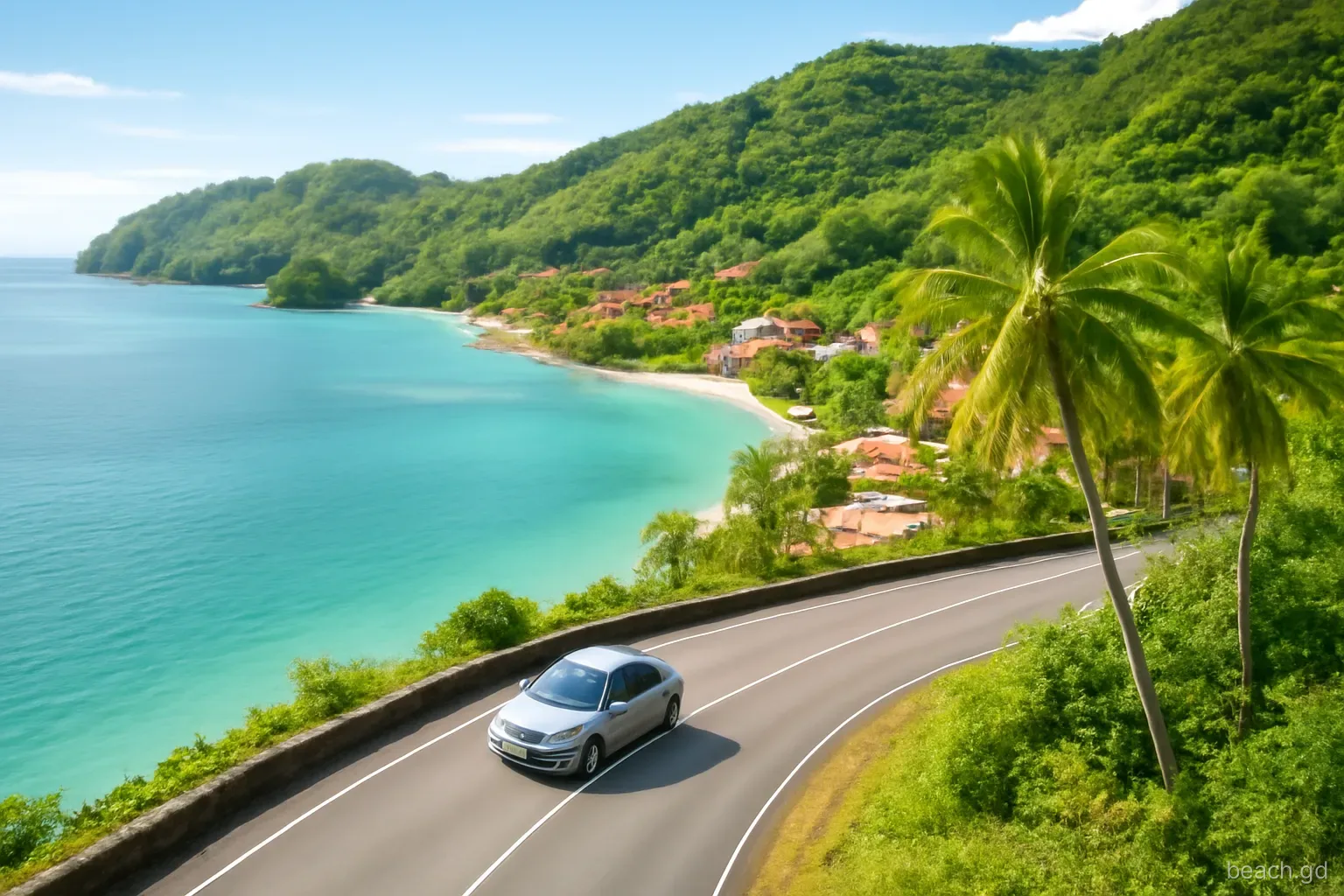
Sauteurs is about an hour and a quarter or more from St George's by the leeward road, and it fits best into a longer day.
- Approach along the west coast through Gouyave and Victoria in the morning, or come from the east via Grenville and Bathway if doing a loop.
- Visit Leapers' Hill and the church first, while the light is clear.
- Walk down to the waterfront to see the boats and the fish market in the late morning.
- Have lunch in town, or at a nearby estate house; Morne Fendue, a historic plantation house in the hills, has long been known for traditional lunches, but booking ahead is essential and arrangements change.
- Swim at Petite Anse or another calm cove if conditions allow, or carry on to Bathway for a supervised swim.
- Leave in good time to drive back in daylight.
Frequently asked questions
Can you swim at Sauteurs Bay?
On calm days, yes, and local people do. The bay faces north, so winter ground swells from about December to March can bring heavy waves and strong backwash. There are no lifeguards, and boats use the beach, so swim away from launch areas and only when it is clearly calm.
What happened at Leapers' Hill?
In the early 1650s, during the French conquest of Grenada, a group of Indigenous Kalinago people were driven to the cliff at Sauteurs and, according to long-standing accounts, jumped to their deaths rather than be captured. The town takes its name from the French word for jumpers.
What islands can you see from Sauteurs?
You can see the small islands north of Grenada, including Caille, Diamond and Ronde, and on clear days Carriacou further away. Between the main island and Ronde lies the submarine volcano Kick 'em Jenny, which is not visible but has a maritime exclusion zone.
How far is Sauteurs from St George's?
It takes around an hour and a quarter or more by car along the leeward coast road, depending on traffic and stops. Route buses run between St George's and Sauteurs through the west coast towns, taking longer with stops along the way.
Is Petite Anse beach worth visiting?
On a calm day it is one of the prettiest swims on the north coast, a small sandy cove facing the Grenadines. Conditions depend heavily on northerly swell, especially in winter, so check the sea before planning a swim. It is quieter than Sauteurs town beach.