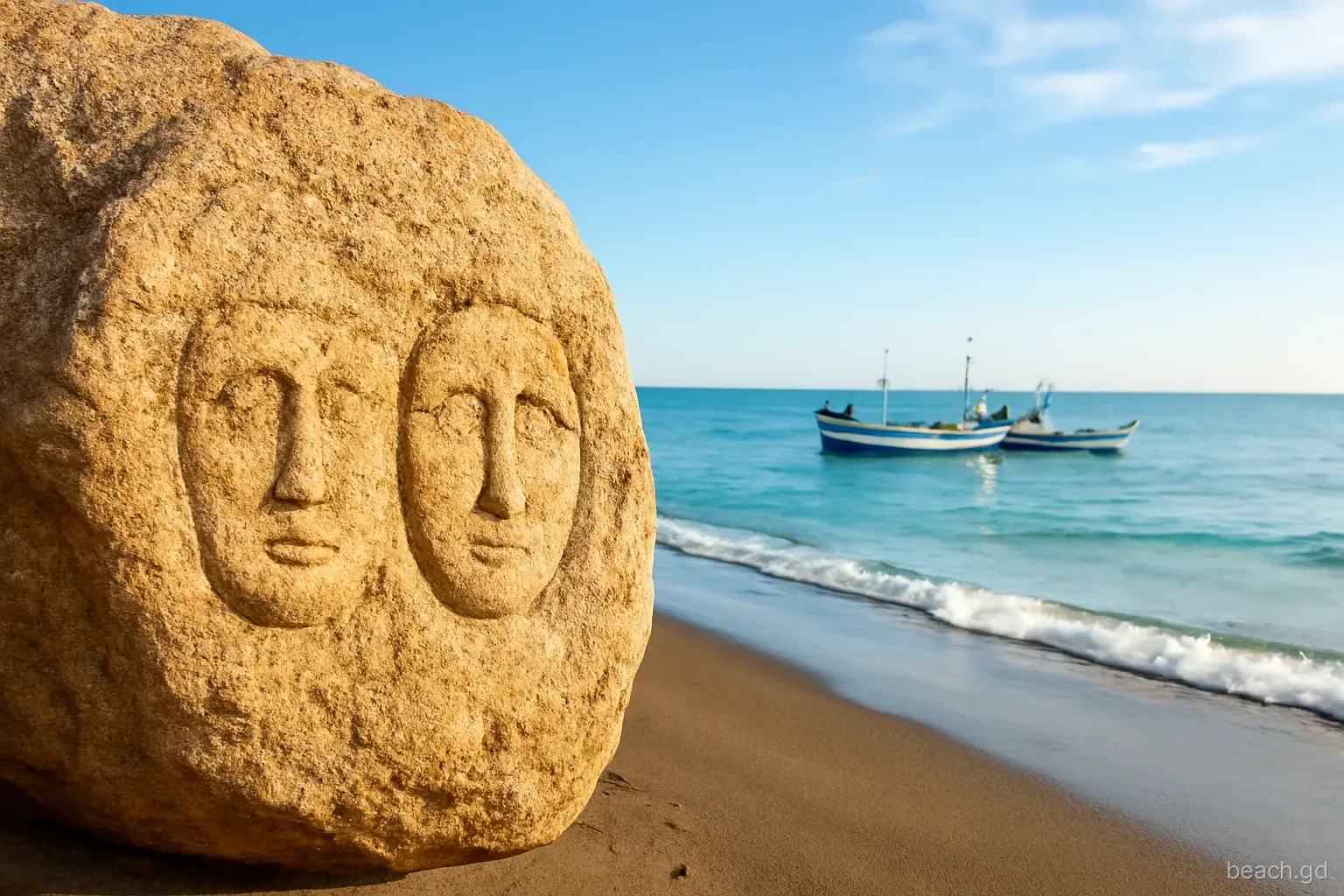
Duquesne Bay is one of those places that most drivers pass without slowing down: a quiet bay of dark sand on the road between Victoria and Sauteurs, with a few fishing boats and a river running out to sea. What makes it worth stopping for is not the swimming but the rocks. On boulders near the shore are petroglyphs, figures carved by the Amerindian people who lived on Grenada long before Europeans arrived.
This page covers what you can see at Duquesne Bay, what the beach and water are like, how to find and look at the carvings without damaging them, and how to fit the bay into a drive along the north-west coast.
The petroglyphs: what they are
Petroglyphs are images pecked or carved into rock. Across the Caribbean they were made by the Indigenous peoples who settled the islands from South America over many centuries before European contact. In Grenada, several sites are known, with Duquesne Bay on the north-west coast and Mount Rich in St Patrick among the most frequently mentioned. The carvings typically show stylised faces, spirals and simple figures, often near water, which suggests they had ritual or symbolic meaning connected to rivers and the sea.
Exactly who made the Duquesne carvings and when is not something that can be stated with precision; archaeologists generally associate Caribbean petroglyphs with pre-Columbian Amerindian cultures spanning many centuries. What is certain is that they are irreplaceable. Unlike pottery in a museum, they sit outdoors, exposed to weather, sea spray and people, and they erode slowly over time.
How to find and see them properly
Ask locally. There are no formal paths or large signs pointing to the carvings, and their location among rocks near the shore is easy to miss. People in the village generally know and will point you in the right direction.
Look with the light. The carvings are shallow and weathered. They show up best in low-angle light, early morning or late afternoon, when shadows bring out the grooves. At midday they can be almost invisible.
Do not chalk, paint or rub. Visitors have historically traced over petroglyphs with chalk or other materials to make them clearer for photographs. This damages the surface and leaves residue. Use light and patience instead.
Do not climb on the rocks. Standing on carved boulders wears the surface and is risky on slippery, sea-washed stone.
Do not scratch new marks. Graffiti on or near petroglyphs is permanent damage to a site that has survived for centuries.
The beach and the water
Duquesne Bay faces west to north-west, with a beach of dark grey to black volcanic sand framed by rocks. It is a working shore: fishing boats are pulled up on the sand, and village life carries on around them. There are no facilities and no lifeguards. The river that runs into the bay carries fresh water and, after rain, brown sediment that clouds the nearshore sea.
On calm days the water is gentle and swimming is possible away from the river mouth and the boats. The beach shelves fairly steeply, so depth comes quickly. Like the rest of the north-west, it is exposed to northerly ground swells in winter, roughly December to March, when waves can dump heavily on the steep sand. On those days it is a place to look at the sea rather than enter it.
The dark sand heats up quickly in the sun. Wear sandals and visit early or late if you plan to stay a while.
Bring water, sun protection and a hat; there is little shade near the rocks, and the reflected heat from dark sand is fierce around midday. A small towel to sit on and a light layer for the breeze are useful if you plan to wait for the low evening light on the carvings.
Mistakes visitors make at Duquesne
Most problems at Duquesne come from treating a heritage site and working beach like a tourist attraction.
- Expecting facilities. There are no toilets, shops or shade structures at the beach. Plan to stop in Victoria or Sauteurs for those.
- Parking on the boat access. The flat ground near the shore is often where boats are hauled. Park on firm ground off the road and away from working areas.
- Swimming at the river mouth. After rain the water there is murky and can carry debris and strong outflow.
- Chalking the carvings for better photographs. It damages them.
- Taking stones or shells. Leave everything in place, especially near the petroglyphs.
- Ignoring local people. A greeting and a question about the carvings usually leads to friendly directions and sometimes a story.
Why protecting rock art matters
Petroglyphs are among the very few direct traces left by the people who lived in Grenada before European colonisation. Pottery fragments and tools tell archaeologists how people lived; carvings in rock hint at how they thought, what they believed and how they marked places of importance. Once damaged, they cannot be restored, and every chalk mark, scratched initial or chipped edge removes part of that record permanently.
Outdoor sites like Duquesne face threats beyond visitors: sea spray, rain, plant roots and the slow erosion of the boulders themselves. Coastal storms can move sand and rocks around them. That makes careful behaviour by visitors all the more important, since it is the one threat that can be controlled. If you notice fresh damage, such as graffiti or chalk, it is worth reporting it to the Grenada National Museum or the relevant heritage authority, without attempting to clean it yourself.
Visiting well also supports the case for protection. Sites that people value and visit respectfully are more likely to receive attention, interpretation and funding over time.
Other heritage nearby
Duquesne is one of several places in the north where Grenada's deeper history sits close to the road. At Sauteurs, a short drive further on, Leapers' Hill marks the site where Kalinago people are said to have leapt from the cliffs in the early 1650s rather than surrender to French forces. Inland in St Patrick, the Mount Rich area is known for another petroglyph site, also best visited with local guidance.
Together these give a sense of the Indigenous presence that shaped the island long before plantations, and the violence of the colonial takeover. The Grenada National Museum in St George's holds Amerindian artefacts found around the island, including pottery, and is worth a visit to put the north coast sites in context. Opening hours should be checked before visiting.
Fitting Duquesne into a north-west drive
The bay is small, and most visits last under an hour. It works best as one stop on a longer drive up the leeward coast, timed so you arrive when the light is low enough to bring out the carvings.
- Drive north from St George's through Gouyave and Victoria, about an hour or so in total.
- Stop at Duquesne in the late morning or late afternoon, when the light suits the carvings.
- Ask in the village for directions to the petroglyphs and spend time looking at them carefully.
- Swim only if the sea is calm, away from the river mouth and the boats.
- Continue to Sauteurs for Leapers' Hill, lunch and the view of the Grenadines.
- Return down the leeward coast before dark, or continue to Bathway on the east coast if doing a loop.
Frequently asked questions
Where are the petroglyphs at Duquesne Bay?
They are carved on boulders near the shore at Duquesne Bay, on the north-west coast between Victoria and Sauteurs. There are no formal paths or large markers, so ask people in the village for directions. They show best in early morning or late afternoon light.
Who made the petroglyphs in Grenada?
They were made by Amerindian peoples who settled Grenada from South America over many centuries before European contact. Exact dates and makers of individual carvings are uncertain. Similar petroglyphs appear across the Caribbean, often near water, suggesting ritual or symbolic meaning.
Can you swim at Duquesne Bay?
On calm days it is possible, away from the river mouth and fishing boats. The dark-sand beach shelves steeply, there are no lifeguards, and winter ground swells from around December to March can make the sea rough. Avoid swimming after heavy rain.
Are there other petroglyph sites in Grenada?
Yes. Mount Rich in St Patrick is another known site, and petroglyphs have been recorded elsewhere on the island and on Carriacou. Local guidance helps, as most sites are small and not signposted. The Grenada National Museum holds Amerindian artefacts that add context.
Is Duquesne Bay worth a stop?
For anyone interested in history, yes. The petroglyphs are a rare chance to see Amerindian rock art in its original setting, and the bay itself is a quiet working beach with sea views. Allow under an hour and combine it with Sauteurs and Leapers' Hill.